Can gum disease be reversed?
The honest answer depends entirely on how far it has gone, and most people are never told which stage they are actually at.

Short answer
Partly. Gingivitis, the earliest stage, is genuinely reversible: the gums can return to full health once the plaque and calculus driving the inflammation are removed. Periodontitis is not reversible, because the bone and attachment already lost around the teeth do not grow back on their own. It can, however, be stopped.
Key takeaways
- Gingivitis reverses. Inflammation without bone loss resolves once the cause is removed, usually within a few weeks.
- Periodontitis does not reverse, but it does stop. The aim shifts from cure to control: halt the loss and hold it there.
- The dividing line is attachment loss, measured with a probe and confirmed on x-rays. It is not something you can judge by how your gums look.
- Bleeding when you brush is not normal, and it is the earliest sign most people ignore.
- Bone loss is silent until it is advanced. Teeth rarely feel loose until a great deal of support has already gone.
- Stability depends on maintenance, not on the treatment alone.
On this page 9 sections
- Which stage you have decides the answer
- Gingivitis: the stage that genuinely reverses
- Periodontitis: what cannot be undone
- How a periodontist tells the two apart
- What treatment actually involves
- Why it progresses in some people and not others
- Can lost gum and bone be rebuilt?
- What you do at home decides whether it holds
- When to ask for a specialist opinion
Which stage you have decides the answer
Gum disease is not one condition. It is a progression, and the point at which it is caught changes what is realistically achievable.
In the earliest stage the inflammation sits in the soft tissue only. Nothing structural has been lost, so removing the cause allows the tissue to recover completely. Once the disease crosses into the bone that holds the teeth in place, that recovery is no longer on offer. What is on offer is stopping it.
This is the distinction that gets lost in most general advice about gum health, and it is the reason two people can be told the same thing and have very different prospects.
| Stage | What has happened | Reversible? | Realistic goal |
|---|---|---|---|
| Gingivitis | Inflammation of the gum only. No bone or attachment lost. | Yes | Full return to health |
| Early periodontitis | Attachment and a small amount of bone lost. | No | Stop the loss, keep every tooth |
| Moderate periodontitis | Deeper pockets, clear bone loss on x-ray. | No | Stabilise, then maintain for life |
| Severe periodontitis | Major bone loss, teeth may be mobile. | No | Save what is savable, plan for what is not |
Gingivitis: the stage that genuinely reverses
Gingivitis is inflammation caused by bacterial plaque sitting undisturbed along the gum line. The gums become red, swollen and bleed easily, particularly when brushing or flossing.
Because no bone or attachment has been lost, the tissue has everything it needs to recover. Remove the plaque and the hardened calculus it forms into, keep the area clean, and the inflammation settles. For most people that means a professional clean and a genuine change in daily technique.
- Timeframe: gums typically settle within two to three weeks of the cause being removed.
- What it takes: professional removal of plaque and calculus, then daily cleaning that actually reaches the gum line.
- What it does not take: surgery, antibiotics in most cases, or anything expensive.
The signal people talk themselves out of
Bleeding when you brush is not a sign you are brushing too hard. It is a sign of inflammation. Healthy gums do not bleed when cleaned properly, and treating the bleeding as normal is how gingivitis is allowed to progress.
Periodontitis: what cannot be undone
When inflammation extends below the gum line it begins to destroy the periodontal ligament and the bone anchoring the tooth. That lost attachment does not regenerate spontaneously. This is why periodontitis is described as manageable rather than curable.
The disease itself can be arrested. Pockets can be reduced, inflammation can be resolved, and bone loss can be halted where it is. What cannot happen is the bone simply filling back in because the area is now clean.
It is also more common than most people assume, and it climbs steeply with age.
| Age group | Proportion affected |
|---|---|
| 15 to 34 | 12% |
| 35 to 54 | 33% |
| 55 to 74 | 51% |
| 75 and over | 69% |
Those figures come from the Australian Institute of Health and Welfare. They describe how ordinary this condition is, not how inevitable: the progression is driven by factors that can be identified and managed.
How a periodontist tells the two apart
You cannot tell by looking, and neither can a patient assess it at home. The distinction rests on measurements.
- Probing depths. A calibrated probe measures the space between tooth and gum at six points around every tooth. Healthy readings sit at roughly one to three millimetres.
- Attachment level. This is the measurement that matters most. It establishes whether the supporting structure has been lost, or whether the gum is simply swollen.
- Bleeding on probing. Recorded per site, this maps where the disease is currently active rather than where it has been.
- Radiographs. X-rays show the bone level directly and reveal loss that no examination of the soft tissue would find.
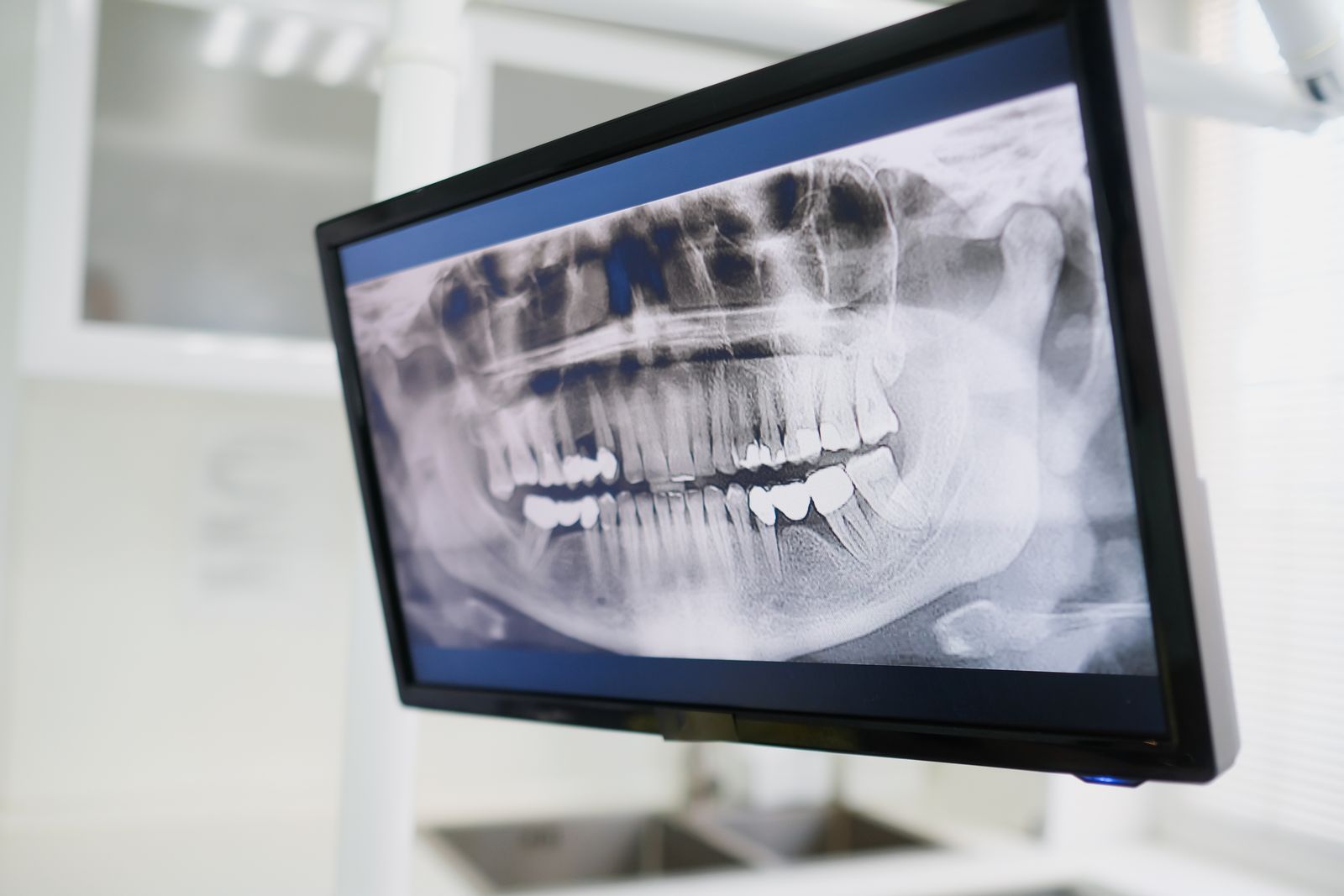
A full periodontal assessment produces a chart of the whole mouth rather than a general impression. That chart is also the baseline that later appointments are measured against, which is how stability is confirmed rather than assumed. You can read more about the gum conditions behind these symptoms and how each presents.
What treatment actually involves
For the large majority of people, the first phase is non-surgical and it does most of the work.
Non-surgical periodontal treatment means thoroughly debriding the root surfaces below the gum line, removing the calculus and bacterial biofilm the toothbrush cannot reach. It is usually completed over a small number of longer appointments, with local anaesthetic where needed.
The tissue is then given time to respond, and re-measured. That reassessment is the point at which it becomes clear whether the disease has been brought under control or whether some sites need more.
- Most sites respond to non-surgical treatment alone.
- Deep pockets that persist may need surgical access to be cleaned properly.
- Smoking and poorly controlled diabetes both reduce how well the tissue responds, and both are worth addressing alongside the treatment itself.
- Results vary between individuals, and suitability for any approach depends on a clinical assessment.
Why it progresses in some people and not others
Plaque is necessary for periodontitis but it is not sufficient. Two people with similar oral hygiene can have very different outcomes, and the difference is largely in how their body responds to the bacteria and what else is going on with their health.
This matters to the question of reversal, because stabilising the disease means addressing the drivers as well as cleaning the teeth. Treatment that ignores an active risk factor tends not to hold.
| Factor | Why it matters | Can it be changed? |
|---|---|---|
| Smoking and vaping | The single strongest modifiable risk factor. It also constricts blood flow, so gums bleed less and the disease looks quieter than it is. | Yes |
| Diabetes control | The relationship runs both ways: raised blood glucose worsens periodontal outcomes, and periodontal inflammation makes glucose harder to control. | Yes, with your GP or endocrinologist |
| Plaque control between teeth | The surfaces a toothbrush cannot reach are where the disease starts. | Yes |
| Medications | Some cause dry mouth, and a few cause gum overgrowth that makes cleaning harder. | Sometimes, with your prescriber |
| Family history | Susceptibility runs in families. It changes how closely you need monitoring, not whether treatment works. | No |
| Age | Prevalence rises steadily with age, largely as accumulated exposure. | No |
The two on that list worth the most attention are smoking and diabetes, because both are modifiable and both have a large effect. Smoking in particular is worth knowing about for a second reason: because it suppresses bleeding, a smoker can have advanced disease and very little of the warning sign that usually prompts someone to get it checked.
What this means for the answer
If you have gingivitis and you remove the cause, it reverses. If you have periodontitis, stability depends on the treatment and the risk factors together. That is why two people can have identical treatment and different long-term outcomes, and it is not a reason to skip treatment: it is a reason to be specific about what is driving it in your case.
Can lost gum and bone be rebuilt?
Sometimes, in specific circumstances, and not as a matter of routine.
Certain patterns of bone loss are amenable to regenerative procedures, and receded gum tissue can in some cases be restored with a gum graft. Whether either is appropriate depends on the shape of the defect, the health of the surrounding tissue, and whether the underlying disease has been stabilised first. Rebuilding around an active infection is not viable.
These are surgical procedures and they should be considered on that basis.
Any surgical or invasive procedure carries risks. For periodontal surgery and grafting these can include infection, bleeding, post-operative discomfort and swelling, sensitivity, incomplete correction of the defect, graft failure, and recession at the donor or treated site. Individual results vary and depend on factors including healing response, smoking status and general health. Non-surgical management and monitoring are alternatives in many cases. Suitability can only be established through an individual clinical assessment, and you are encouraged to seek a second opinion before proceeding.
What you do at home decides whether it holds
Treatment removes the accumulated damage. It does not change the conditions that produced it. Without a change in daily cleaning, the bacteria reorganise and the disease resumes.
- Clean between the teeth daily. A toothbrush reaches roughly three of the five surfaces of a tooth. Periodontal disease starts on the ones it misses.
- Interdental brushes over floss where the spaces allow it, sized to the gap rather than bought as one size.
- Angle the brush into the gum line at about 45 degrees. Most people clean the tooth and miss the margin where the problem lives.
- Keep the maintenance interval you are given. Periodontal maintenance is usually more frequent than a routine six-month check, and the interval is set from your own risk, not a standard schedule.
Stability is not a single event. It is the product of the treatment and the maintenance that follows it, and the second part is the one that determines the long-term result.
When to ask for a specialist opinion
Most gum disease is managed well in general practice. A specialist opinion is worth seeking when the picture is more complicated than a routine clean will resolve.
- Pockets that remain deep after thorough non-surgical treatment.
- Bone loss that is advancing despite good home care.
- Gum recession that is progressing, or affecting how you feel about your smile.
- Teeth that have become mobile, or have started to drift.
- Gum disease alongside a plan for implants or orthodontics, where stability has to be established first.
A referral is not a judgement on the care you have had. It usually means the case warrants the extra measurement, imaging and time that specialist practice is set up for. As a specialist periodontist in Sydney, Dr Hui sees patients on referral from general dentists and directly from patients across Neutral Bay, Newcastle and Kiama.
Common questions
Can gum disease go away on its own?
Gingivitis will not resolve while the plaque and calculus causing it remain in place, and calculus cannot be removed by brushing. Periodontitis does not resolve without treatment at any stage.
How long does it take to reverse gingivitis?
Once the cause has been professionally removed and daily cleaning improves, the inflammation usually settles within two to three weeks. Persistent bleeding beyond that is worth reassessing, as it can indicate that the disease has already progressed further than the gum appearance suggests.
Does gum disease always lead to losing teeth?
No. Diagnosed and managed, the great majority of teeth affected by periodontitis are retained. Tooth loss is the outcome when the disease goes undetected or unmanaged over a long period, not an inevitable endpoint.
Will a scale and clean fix periodontitis?
A routine scale and clean addresses deposits above and just below the gum line. Periodontitis involves calculus and biofilm deeper on the root surface, which requires a different procedure, more time, and usually local anaesthetic.
Can bone lost to gum disease grow back?
Not on its own. Certain defect shapes can be treated with regenerative procedures, but this depends on the specific pattern of loss and requires the disease to be stabilised first. It is not applicable to every case, and results vary.
Is gum disease linked to other health conditions?
Periodontitis is associated with several systemic conditions, most consistently with diabetes, where the relationship runs in both directions: poorly controlled blood glucose worsens periodontal outcomes, and periodontal inflammation makes glycaemic control harder. This is a reason to mention your medical history at assessment.
In short
The answer
Gingivitis reverses completely once the cause is removed. Periodontitis does not, because lost bone and attachment do not return on their own, but it can be stopped and held stable for the long term. Which of the two you have is decided by measurement, not appearance, and that distinction is the whole answer.
Get a clear answer on which stage you are at
A full periodontal assessment measures the attachment around every tooth and establishes whether what you have is reversible or needs to be stabilised.
References